

Pocketknives
France, like no other country in Europe, has generated a wide variety of pocket knives in its regions. Thiers in Auvergne is without a doubt the centre of cutlery craftsmanship today and is ... know more
France, like no other country in Europe, has generated a wide variety of pocket knives in its regions. Thiers in Auvergne is without a doubt the centre of cutlery craftsmanship today and is also known as La Capitale de la Coutellerie. But the comparatively small village of Laguiole in Aubrac is perhaps better known because of its famous knife. Once important centres such as Châtellerault and Nogent have now lost their significance. PassionFrance® has a small, exclusive workshop in Thiers, where, in addition to a range of classic knives from the world of regional French knives, the creations of the mof² (two times Best Craftsman of France), Robert Beillonnet, are also produced. Some of the knives won international awards.
The history of knives.
Knives have accompanied humans since the beginnings of human history. They are the first tools created by humans. When the first cutting edges were created on carved stones in Africa two million years ago, the first step was taken; followed by hand axes and arrowheads made of flint. When people learned how to work with metals 5,000 years ago, the result was knives and cutting tools as we know them today. In a further step, it became possible to make the previously fixed knives foldable so that they could be carried in a pocket.
Pocket knives are technically more complex than knives with fixed blades. They probably originated before the Middle Ages, as recent archaeological finds show. Some suspect that they originated even earlier, perhaps with the Romans, but there are no finds to date that clearly prove this. In its earliest form, a pocket knife consists of only three parts: blade, handle and blade axis.
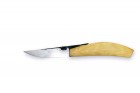 | One of the finest examples of a medieval ‘PIEMONTAIS’ is an archaeological find in London, reconstructed by Yannick Epiard. Thanks to dendrochronological analysis, the knife has been dated to the 13th century. It consists of exactly these three parts. When open, an extension of the blade, the so-called "lentille", rests on the back of the handle, preventing the blade from opening further. All of its formal elements are typical of the High Gothic period: it is extremely elegant. Nothing about it is superfluous. 700 years before the Bauhaus in Dessau coined the motto, the principle of form follows function already applied here. |
 |
|
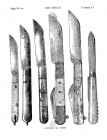
Over the last two centuries, pocket knives have evolved into the shapes we know today. Some types disappeared, while others evolved and underwent technical improvements. Sizes and shapes always came from everyday use. The materials used for the handles also varied, always responding directly to buyers' needs and the specifics of their region. The regional knives of France are deeply connected to their terroir, telling a story about the characteristics of their regions, the daily lives of the people, their activities, and their status. Farmers, citizens, aristocrats ... It's no surprise that these knives have become symbols of their homeland, an integral part of history, culture, and tradition of their region, proudly carried in people's pockets.
In addition to his book about LAGUIOLE, history expert Christian Lemasson has published another standard work on regional knives in France: ‘L'histoire des Couteaux Régionaux’. We have also translated this book from French, so that it is now available in German as ‘MESSER AUS FRANKREICH’ (Knives from France).
Some of the knives displayed there have disappeared in recent decades and now only exist in collections or museums. Others have spread and improved technically over the generations. For enthusiasts and collectors who appreciate the beauty of regional models, PassionFrance® manufactures pocket knives in its workshop in Thiers. Some of them were designed by the famous knife maker and mof² (Best Craftsman of France) Robert Beillonnet, and some have received international awards.
Only the best blade steels and selected handle materials are used for our knives: fine-grained high-carbon steel XC75, stainless Sandvik 14C28 or powder metallurgical RWL34. For individual pieces and custom-made items, we use damask steels from various forges. All our knives are 100% handmade: Agenais, Alpin, Basque-Yatagan, Donjon, Laguiole-Droit, Laguiole, London, Mineur, Poisson-Culot, Seurre, Saint-Amans, Vendetta and the Yssingeaux. You can also purchase some knives from our knife-making colleagues, most of whom are our neighbours. With its expertise, PassionFrance® offers what is probably the largest range of regional French pocket knives. Please contact us if you have any questions or visit us in our showroom in Darmstadt.
Agenais (7)
184,00 € — 199,00 €
Alpin (15)
159,00 € — 318,00 €
Alsacien (1)
145,00 €
Basque-Yatagan (1)
199,00 €
Capucin (1)
340,00 €
Corse-Curnicciolu (1)
99,00 €
Corse-Yatagan (1)
89,00 €
Donjon (2)
190,00 € — 199,00 €
Douk-Douk (7)
38,00 € — 74,00 €
Garonnais (1)
110,00 €
Laguiole-Droit (1)
3350,00 €
Laguiole (154)
50,00 € — 1899,00 €
Sommelierbesteck-Laguiole (8)
179,00 €
Liadou (8)
114,00 € — 540,00 €
London (18)
89,90 € — 280,00 €
Mineur (6)
173,50 € — 189,00 €
Montpellier (1)
99,00 €
Vendetta (6)
40,00 € — 199,00 €
Nontron (1)
Price on request
Poisson-Culot (1)
210,00 €
Queue de Poisson (3)
64,00 € — 71,00 €
Rouennais (2)
226,00 € — 760,00 €
Saint-Amans (5)
199,00 € — 230,00 €
Seurre (9)
250,00 € — 270,00 €
Sujet (14)
26,00 € — 57,00 €
Stephanois-Sifflet (1)
28,00 €
Thiers (8)
50,00 € — 199,00 €
Tonneau (1)
120,00 €
Truffier/Champignon (1)
99,00 €
Yssingeaux (1)
Price on request